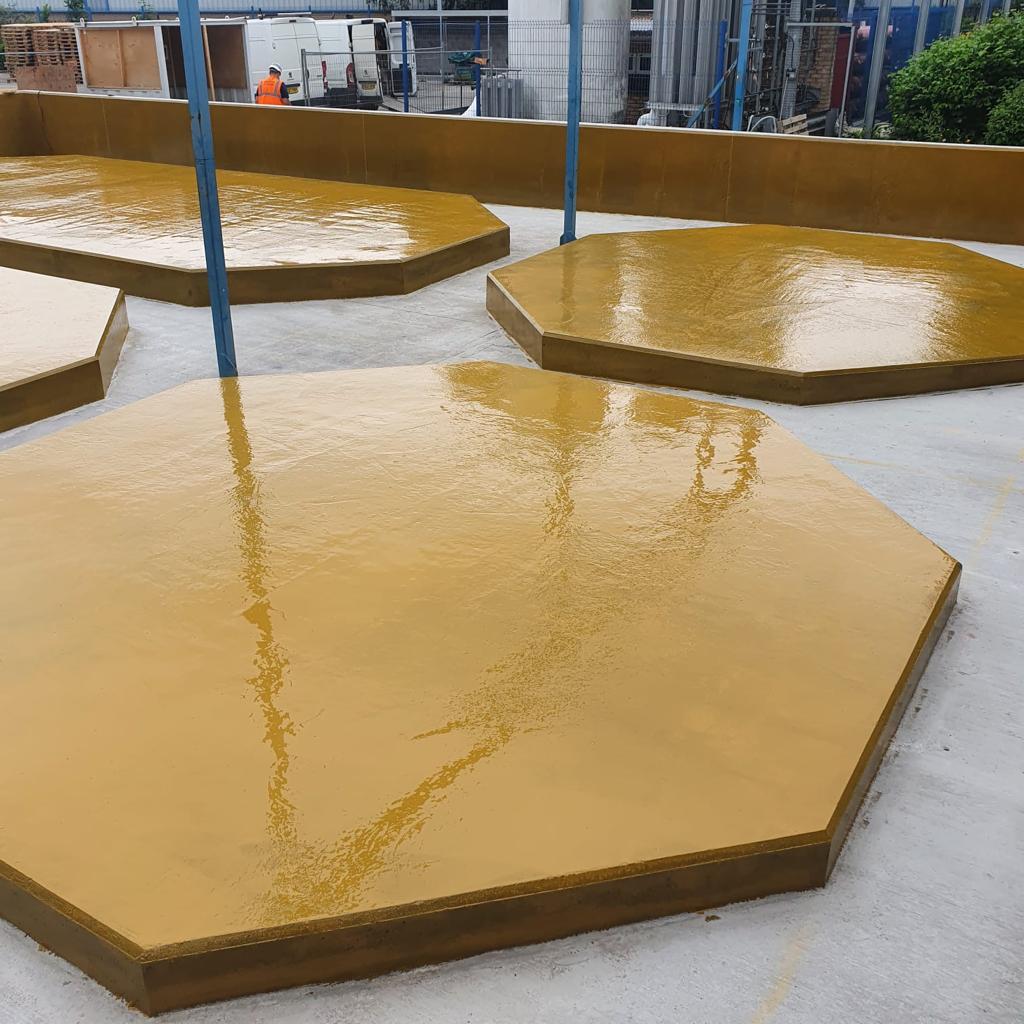

Retail Fuel & Forecourts
In retail fuel and forecourts, bund lining is the chemically resistant barrier that turns concrete tank chambers, fill point manholes, dispenser sumps and surface bunds into compliant fuel containment systems.
Key Bund Lining Challenges in Retail Fuel and Forecourts
Retail fuel and forecourts is the most public-facing fuel handling sector in the country — and one of the most heavily regulated. Containment failures show up immediately as environmental incidents, and the pressure to keep dispensers live around the clock means lining work has to fit some of the tightest access windows in industry. A compliant fuel bund on a forecourt has to deliver fuel containment, weather tolerance and safe live working from a single specification and demonstrate it on a Trading Standards visit without ambiguity. The challenges that shape every forecourt specification we write include:
When Is This Required?
Retail Fuel & Forecourts Common Applications
Forecourts carry a wider range of containment assets than the dispensers and tanks visible from the customer side. Common applications we line include:
Tank chamber and tank pit linings around single-skin and double-skin underground storage tanks (USTs)
Fill point manhole and offset fill chamber linings, including spill containment manholes
Dispenser sumps and pump island containment sumps under each forecourt pump
Bunded tank lining on above-ground storage tanks (ASTs) at smaller depots and rural sites
Surface bunds around AGI (above-ground installation) tanks, generators and bulk storage
Forecourt manhole and chamber covers where containment integrity carries through every penetration
AdBlue tank bunds, dispensing chambers and fill points
Used and waste oil bunds at forecourts with workshop and fast-fit services
Vapour recovery sump linings and fill point detail areas
Lubricant store bunds and oil dispensing bay floors
Fuel offload aprons and tanker stand-off areas
Diesel fuel spill containment sumps at HGV refuelling lanes and commercial pump islands
Standby diesel generator bunds for forecourts with on-site backup power
Compressor and air system bunds on forecourt service islands
Retail Fuel & Forecourts Regulatory and Compliance Obligations
Retail fuel and forecourts sit under a layered regulatory framework that combines petroleum, environmental and workplace safety obligations. Reschem operates as both hydrocarbon bund installers and hydrocarbon bund suppliers in this sector, so specifications are written, supplied and applied with the full forecourt regulatory framework in mind from the outset. The principal references we design to are:
The Petroleum (Consolidation) Regulations 2014 (PCR 2014)
The headline UK rules for storage, dispensing and certification at filling stations, enforced by the Petroleum Enforcement Authority.
The APEA / Energy Institute "Blue Book"
Design, Construction, Modification, Maintenance and Decommissioning of Filling Stations — the working reference for every forecourt build and refurbishment in the UK.
DSEAR (Dangerous Substances and Explosive Atmospheres Regulations) and ATEX zoning
Strict and comprehensive across the forecourt envelope.
HSE HSG41
Petrol filling stations: construction and operation.
Environment Agency
PPG2 (oil storage) and the EA position statements on retail fuel storage.
The Control of Pollution (Oil Storage) (England) Regulations and equivalents
Applicable where above-ground storage falls within scope.
The Energy Institute Model Code of Safe Practice
Particularly Parts 1, 2 and 21, which set practical containment expectations.
ADR (the Carriage of Dangerous Goods Regulations)
Applicable to tanker offloading, with knock-on impact on offload area containment.
Local Authority Environmental Health and Trading Standards
The day-to-day inspection touchpoint for most operators.
Customer technical standards issued by major brands (BP, Shell, Esso, supermarket retailers)
Typically tighter than the underlying regulation, and often the document that drives material specification.
Retail Fuel & Forecourts Recommended Lining Systems
Resin selection in retail fuel is dominated by hydrocarbon resistance, ethanol blend tolerance and the practical realities of working under DSEAR controls. Our typical palette is:
Epoxy Resins
The workhorse for forecourt bunds, dispenser sumps and fill point chambers, where reliable diesel and petrol resistance, sound adhesion to concrete and predictable performance under PEA inspection make epoxy the default for most fuel bund lining work.
Polyurethane Resins
Selected for outdoor surface bunds, tank chamber lids and offload aprons exposed to UV and thermal cycling, where rigid epoxies would crack or yellow over the asset's life.
Polyurea Resins
Rapid-cure systems used on live forecourts to return a sump or bund to service inside a single overnight closure. Particularly valuable on supermarket forecourts and motorway service areas where extended downtime is commercially unacceptable.
Vinyl Ester Resins
The chemistry of choice for ethanol-blended petrol, oxygenated fuels and FRP bund lining work in tank chambers, where glass-mat reinforcement and acid-tolerant resin combine into a fibreglass bund lining capable of handling the most aggressive forecourt fuels.
Novolac Epoxy Resin
Uprated chemistry for sites handling unusual fuel blends, hot biodiesel returns and any forecourt where standard epoxies would soften under elevated-temperature exposure.
Speak to a Specialist
Our technical team can advise on the right system for your project.
Retail Fuel & Forecourts FAQs
A correctly specified and maintained forecourt lining typically delivers 15–25 years of compliant service in tank chambers, fill point manholes and surface bunds. Dispenser sumps and high-traffic offload aprons tend to sit at the lower end of that range, with planned re-coats often timed to coincide with pump replacement or major refurbishment.
This is often the case, yes. Most forecourt work is staged into overnight closures, with rapid-cure polyurea systems returning a dispenser sump or fill point chamber to service before the morning trade. Where a full pump or tank isolation is unavoidable, work is programmed around the shortest viable outage agreed with the operator.
Run a visual inspection at least annually as part of routine forecourt maintenance, with additional checks at every PCR 2014 site inspection and after any spill or significant rainfall event. Tank chamber and fill point chamber linings should be inspected and integrity-tested in line with the operator’s asset management policy and customer brand standards.
Repairs are carried out under permit-to-work with DSEAR controls, the affected pump or tank isolated, residual fuel and water removed, and the substrate decontaminated before any preparation begins. The new lining is applied to the original specification, allowed to cure to walk-on or service-on as required, and signed back into operation through the operator’s change control process.
Petrol and diesel attack unsuitable resins by softening, swelling and dissolving them. However, modern fuel-resistant epoxies, vinyl esters and polyureas are formulated specifically to resist this exposure for long service life. Ethanol-blended petrols (E5 and E10) are noticeably more aggressive than legacy unleaded, which is why vinyl ester or premium epoxy systems are now standard on tank chamber linings.
Outdoor surface bunds and tank chamber lids cycle through daily and seasonal temperature swings that crack rigid coatings, while UV exposure breaks down standard epoxy topcoats over time. Polyurethane topcoats and crack-bridging build-ups are specified on exposed forecourt elements precisely to manage this, and buried elements are detailed for freeze-thaw and groundwater pressure.
Yes, lining systems span both UST tank chambers (typically lined as a fully laminated FRP / fibreglass bund lining) and AST surface bunds (typically multi-coat resin systems), with primer and topcoat chemistry matched to the substrate and the specific fuel held above. The approach differs in geometry and access more than in fundamental material choice.
We match each lining specification to the fuel mix actually held at the site, using manufacturer compatibility data, immersion testing where required, and the brand’s approved material lists where the operator has one. Site-specific risk is assessed in advance, so the system installed is documented as suitable for the petrol, diesel, ethanol blend or AdBlue duty it will see in service.
Featured Case Studies