

Surface Preparation
Surface preparation is the build up method that sits underneath every other one we deliver. It is the mechanical and chemical work that turns a contaminated, smooth or unsound substrate into a clean, profiled, fully bondable surface ready for a bund lining. Get it right and every later step performs as designed; get it wrong and even the best resin will debond, blister and fail well inside its design life.
How Surface Preparation Works
We treat surface preparation as the engineering operation it is, not a routine site task. Every step has a measurable outcome, and the whole sequence runs against the standard the chosen lining system requires. Our standard sequence is:
When Is This Required?
Surface Preparation Types
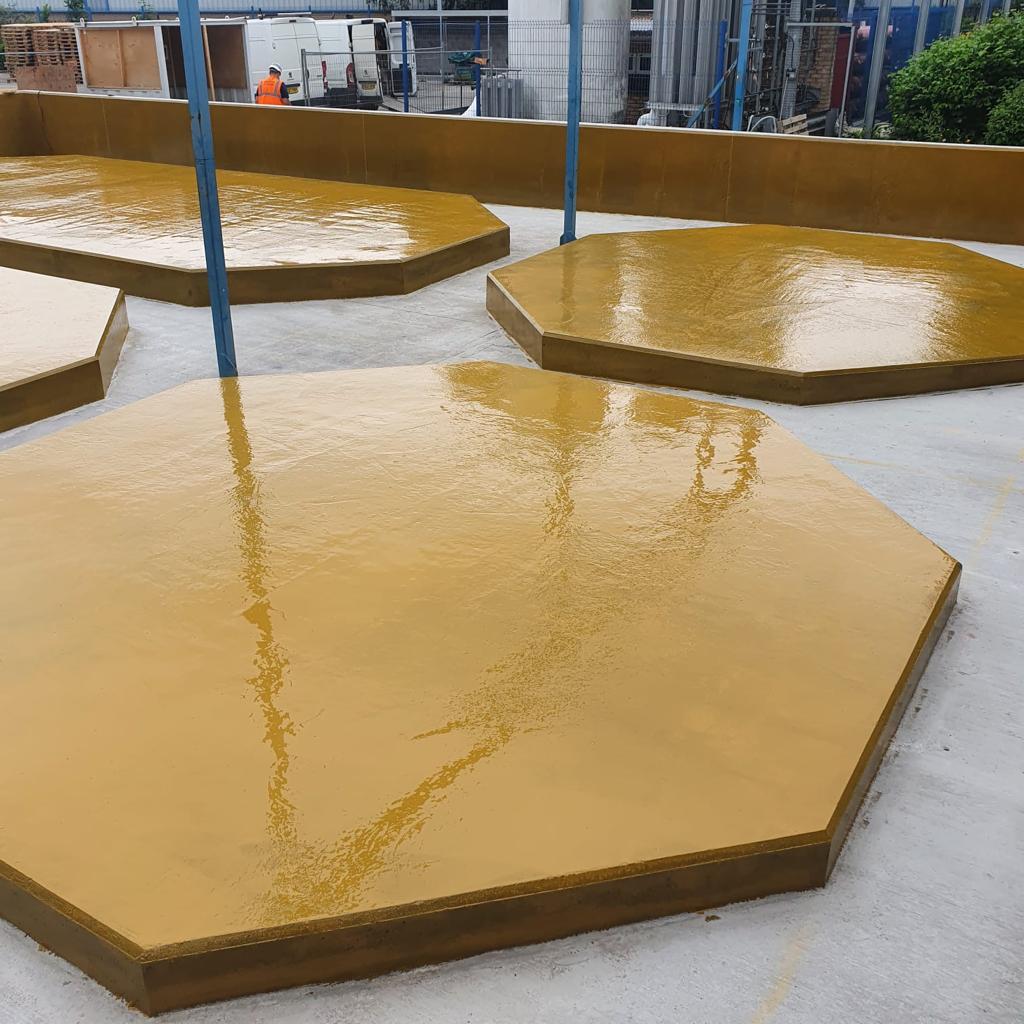
Surface Preparation Performance and Profile
Surface preparation does not add thickness, it removes substrate to expose a profiled bonding surface. Performance is judged on measured profile depth, cleanliness and moisture rather than dry film thickness:
- Light preparation: ICRI CSP 2–3, suitable for thin-film coating work where chemistry is moderate and surface profile is the primary requirement.
- Standard preparation: ICRI CSP 3–5, the typical specification for most bund coating work in the UK across both new build and refurbishment.
- Heavy preparation: ICRI CSP 5–7, used as the base for trowel-applied mortar systems and most reinforced lay-up work, with deeper mechanical profile to lock the build-up into the substrate.
- Aggressive preparation: ICRI CSP 7–9, reserved for heavy-duty trowel mortars, structural rebuild and severely contaminated or chemically attacked substrates.
Steel preparation runs on a different scale. This is typically SA 2.5 (near-white metal) for protective coating work, with SA 3 (white metal) used for the most demanding immersion duty.
Surface Preparation by Resin System
Surface preparation is the foundation for every resin in our range. It is not the lining material itself, but the prep regime is tailored to whatever is going on top. The expected pairing is:
Epoxy Resins
Typically applied over CSP 3–5 prep on concrete, with a documented penetrating primer matched to the chosen system.
Polyurethane Resins
Similar prep to epoxy, with additional moisture verification given PU's sensitivity to substrate water content.
Polyurea Resins
Usually require more aggressive prep (CSP 5–7) because of their rapid cure and limited substrate wetting time, with a primer specifically engineered for polyurea over-application.
Vinyl Ester Resins
Applied over heavy preparation (CSP 5–9), particularly where FRP/GRP lay-up work is being installed, with vinyl-ester-compatible priming.
Novolac Epoxy Resin
Heavy preparation followed by novolac primer, with strict attention to moisture and contamination given the demanding service novolac is normally specified for.
Advantages of Surface Preparation
Surface Preparation Limitations
Need a lay-up specified for a demanding bund?
Speak to Reschem about the right laminate build-up, resin choice and inspection regime for aggressive chemical duty, confined structures or long-life containment assets.
When to Choose Each Surface Preparation Method
Surface preparation is mandatory on every bund lining project; the question is which variant. Our typical decision criteria are:
Use Grit Blasting
When access, dust control and DSEAR zoning all allow open-nozzle work, including new build and refurbishment outdoors or in non-hazardous areas.
Use Captive (vacuum) Vlasting
When dust must be controlled. Live plant, food and pharmaceutical environments, ATEX-zoned areas and inside occupied buildings.
Use Shot Blasting
For floor work over large open areas where uniform profile and minimal mess matter, including warehouse and production hall bunds.
Use Diamond Grinding
For detail work, edge preparation, profile correction or where blasting is impractical, and as the standard for stained or laitance-only floors.
Use Scabbling
When 1–10 mm of substrate must be removed. Heavy contamination, chemical attack or a bonded failed lining that cannot be blasted off.
Use UHP Water Jetting
For BSA-attacked sewer concrete, water-saturated coatings, hygiene-led environments where dust is unacceptable, and confined spaces with poor ventilation.
Surface Preparation Applications and Industries
Surface preparation is delivered across every sector we work in, with the variant tailored to each environment:
Oil, Gas and Petrochemical
Grit blast and captive blast on tank bunds and tanker offload aprons, with hydrocarbon decontamination as part of the regime.
Power Generation and Transmission
Careful, dust-controlled preparation around live substations, including blasting of substation oil containment systems and steel transformer plinths to SA 2.5 or better.
Food & Beverage
Captive blasting and UHP water jetting for hygiene-led production floors, where open-nozzle dust is incompatible with operational areas.
Sewage and Waste Water Treatment
UHP water jetting on BSA-attacked concrete in sewers, wet wells and digester gas spaces.
Chemical Processing
Heavy preparation with chemical decontamination on contaminated substrates around dosing skids, drum decks and reaction floors.
Agriculture & Aquaculture
Shot blasting on slurry tanks, silage clamps and AD plant bunds, often after biofilm and product-residue removal.
Nuclear Facilities
Captive blasting and decontamination-aware preparation, with HEPA-filtered extraction and arisings managed as the appropriate radioactive waste category.
Surface Preparation Acceptance Criteria
Surface Preparation Quality Assurance and Testing
Surface Preparation FAQs
Inadequate preparation is the leading cause of lining failure across the industry, producing debonding, blistering, osmotic attack and premature loss of containment. The lining itself usually looks fine at handover; the failure shows up months or years later, at which point a full re-line is the only viable remedy.
We measure profile (ICRI CSP or ISO 8503), cleanliness (ISO 8501-1 and ISO 8502-3), moisture content, substrate temperature and dew point, and record each result against the manufacturer’s specification. The substrate is only signed off and primed when every measurement is inside the specified envelope.
Yes, preparation can be staged across multiple bunds, multiple shutdowns or different parts of a single asset, with each phase prepared, verified and primed within its own window. The constraint is that prepared substrate must be primed before it weathers or contaminates, so phasing is planned around that recoat window.
Survey and setup typically takes a half-day, abrasive preparation half a day to two days depending on area and method, decontamination and detail work a half-day, and verification and priming a half-day. A typical bund of moderate size is therefore prepared and primed within two to four working days of arrival on site.
Surface preparation is the single largest factor in long-term lining performance, and well-prepared substrates routinely deliver the upper end of the 15–25 year service envelope. Poorly prepared substrates rarely reach half that figure regardless of how good the lining material above them is.
The principal references are HSE guidance on grit blasting and abrasive use (including HSG258 on extraction), COSHH for dust and abrasive selection, DSEAR where work takes place in hazardous zones, LOLER for any blasting equipment requiring inspection, and the Hazardous Waste Regulations for arisings disposal. Sector-specific frameworks such as COMAH and BS 4247 apply on top of this where the asset is in scope.
Featured Case Studies

Get Independent Expert Advice
Speak to our technical specialists about your bund lining requirements. Free, no-obligation site surveys available nationwide.
