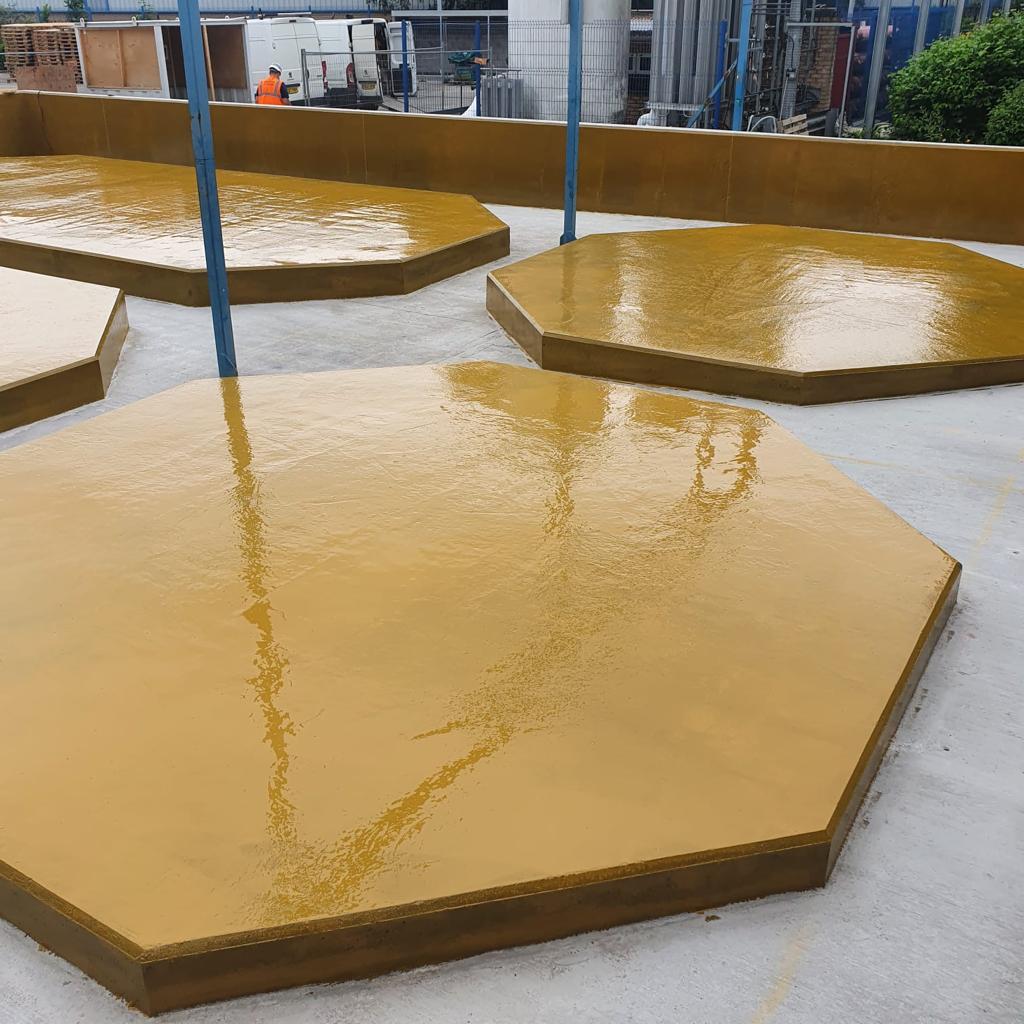

Pharmaceutical and Life Sciences
In pharmaceutical and life sciences, bund lining is the GMP-compliant, chemically resistant barrier that protects cleanrooms, API synthesis bays, fermentation suites and active waste areas from spillage, sanitisation chemistry and cross-contamination.
Key Bund Lining Challenges in Pharmaceutical and Life Sciences
Pharmaceutical and life sciences sites are unusual in that the bund lining is part of two control regimes at once – environmental containment and GMP compliance. The chemistry is varied, the cleanliness expectations are absolute, and every change to a finished surface has to be justified, validated and documented. A chemical resistant lining for a pharmaceutical site has to do all of this without compromising the GMP environment around it. This is what GMP-compliant containment solutions actually mean in practice. The challenges that shape every specification we write in this sector include:
When Is This Required?
Pharmaceutical and Life Sciences Common Applications
Bund lining and structural coatings in pharmaceutical and life sciences sit across a wide spread of process and support areas. Common applications we line include:
API synthesis bay floors, plinths and bund walls
Reactor, vessel and dosing skid bunds in solid and liquid dosage manufacture
Hydrochloric acid tank lining and other concentrated acid storage compounds
Sodium hydroxide, sulphuric and nitric acid bunds in synthesis and CIP duty
Solvent storage compounds for ethanol, IPA, methanol, acetone, DCM and DMF
Cleanroom floors, coved upstands and the lower section of cleanroom wall systems
Fermentation suites, bioreactor surrounds and downstream processing (DSP) area floors
Sterile fill-finish ancillary areas, change rooms and gowning suites
HVAC plant rooms, AHU bunds and condensate recovery areas
WFI, purified water (PW) and clean steam plant rooms
CIP/SIP set bunds and chemical store rooms for caustic, acid and sanitiser bulk
Decontamination corridors, autoclave loading bays and biowaste handling rooms
Cytotoxic, hormonal and HPAPI suites with elevated containment requirements
Quality control, microbiology and analytical lab bunds and wash-down floors
Tanker offloading bays for solvents, acids and bulk APIs
Pharmaceutical and Life Sciences Regulatory and Compliance Obligations
Pharmaceutical and life sciences operators sit under a regulatory framework dominated by quality, patient safety and product integrity, layered on top of the standard environmental and chemical regulations. The principal references we design to are:
EU GMP and the UK GMP Guide
As administered by the MHRA, the foundation document for finished-surface expectations.
EU GMP Annex 1 (revised)
Sterile manufacturing requirements, with explicit expectations on cleanability, surface integrity and contamination control strategy.
EU GMP Annex 15
Qualification and validation, which governs how any change to a lined surface must be justified and re-qualified.
ISO 14644
Cleanroom classification and monitoring, which sets the environmental targets that a finished lining must support.
ICH Q9 (Quality Risk Management) and ICH Q10 (Pharmaceutical Quality System)
The wider quality framework that sits over every facility decision.
GAMP 5
For any computerised testing or validation activity associated with the lining.
COSHH
Applied across solvent, acid and HPAPI handling.
DSEAR
Relevant in solvent storage, dispensing and bulk solvent transfer areas.
Environment Agency PPG2 (oil storage) and PPG18 (chemical handling)
With environmental permit conditions specific to pharmaceutical effluent.
HSE process safety guidance
Including HSG71 for storage of packaged dangerous substances.
Customer audit standards
Internal corporate quality standards, GxP audit programmes and supplier qualification frameworks routinely demand more than the underlying regulation.
Pharmaceutical and Life Sciences Recommended Lining Systems
Resin selection in pharmaceutical and life sciences is dominated by GMP cleanability, validated chemical resistance and the practical realities of working inside qualified areas. Our typical palette is:
Epoxy Resins
The workhorse for cleanroom floors, GMP support areas and standard production bay bunds, where smooth, low-particulate, easily disinfected finishes are the dominant requirement and routine sanitisation chemistry sits well within an epoxy's performance envelope.
Polyurethane Resins
Selected where steam, hot WFI and SIP cycles drive thermal shock, including autoclave loading bays, clean steam plant rooms and pasteurisation areas where rigid epoxies would craze under repeated hot–cold cycles.
Polyurea Resins
Rapid-cure systems for shutdown work where a qualified area must be relined, deep-cleaned and requalified inside a single planned outage. Particularly valuable on multi-product facilities where extended downtime is commercially prohibitive.
Vinyl Ester Resins
The chemistry of choice for hydrochloric acid tank lining, concentrated nitric and sulphuric acid bunds in synthesis, and any zone where strong mineral acids would destroy a standard epoxy. Vinyl esters are also specified in CIP rooms running heavy peroxyacetic or nitric chemistry.
Novolac Epoxy Resin
Uprated chemistry for hot solvent exposure, DCM and DMF spillage zones, and high-concentration acid duty in API plants, where standard epoxies would soften, blister or be chemically destroyed.
Speak to a Specialist
Our technical team can advise on the right system for your project.
Pharmaceutical and Life Sciences FAQs
Yes, properly specified pharmaceutical bund linings are validated against routine CIP, SIP and sanitisation chemistry, including sodium hypochlorite, peracetic acid, IPA and ethanol wipe-down, plus hot WFI and clean steam contact. Material selection is matched to the specific cleaning regime in advance, so the lining is chosen knowing exactly what it will be exposed to.
A correctly specified and maintained pharmaceutical bund lining typically delivers 15–25 years of compliant service across most production duties. Joint sealants, detail treatment and high-traffic coatings are usually re-coated inside that window, often timed to coincide with planned requalification or shutdown campaigns.
This can be done in ancillary, plant room and warehouse areas, However, inside qualified GMP areas, lining work is almost always tied to a planned shutdown so that change control, environmental monitoring and re-qualification can be completed before the area returns to service.
Run a visual inspection at least quarterly inside active GMP areas, supported by formal condition surveys aligned with the site’s validation lifecycle and routine environmental monitoring. Plant room, warehouse and ancillary bunds should be inspected at least annually, with hydrostatic testing in line with environmental permit requirements where applicable.
Repairs are carried out under change control, with permit-to-work, dust containment and decontamination of the substrate before any new material is applied. The repaired area is then deep-cleaned, environmentally monitored and re-qualified through the site’s IQ/OQ/PQ regime before being returned to GMP service.
The most common are concentrated acids (hydrochloric, sulphuric, nitric), strong bases (sodium and potassium hydroxide), process solvents (methanol, ethanol, IPA, acetone, DCM, DMF), and routine sanitisation chemistry (sodium hypochlorite, peracetic acid). Sites handling HPAPIs, cytotoxics or biologics also specify lining protection around bioreactors, fermenters and downstream processing skids regardless of the bulk chemistry alone.
Featured Case Studies